Perslis Defense, the seed deck, in 15 slides. Arrow keys, space or swipe. Every number is from a published Perslis page or the public source named on the slide. Download the PDF ↓
PERSLIS DEFENSE · SEED ROUND
Adaptive autonomy. Fixed authority.
A weightless machine brain that writes its own rules from its failures, runs on the machine with no network link, and plugs into the systems you already field — under human command.
Raising US$5–10M · 24-month runway · team of 5–7
Autonomy is coming at scale. The brains on offer were not built for the field.
Scale is the plan
The Replicator initiative, announced August 2023, set out to field attritable autonomous systems by the thousands, across domains, within 18 to 24 months.
US Deputy Secretary of Defense, Aug 2023
Neural models freeze
Trained before they ship, retrained in a data centre, dependent on a link or a big GPU, unable to show why — and aligned to a vendor’s policy, not your orders.
The force runs on old systems
A system coordinating the nation’s nuclear forces ran on a 1970s IBM Series/1 with 8-inch floppies; about 75% of federal IT spend went to keeping existing systems running.
GAO-16-468, 2016
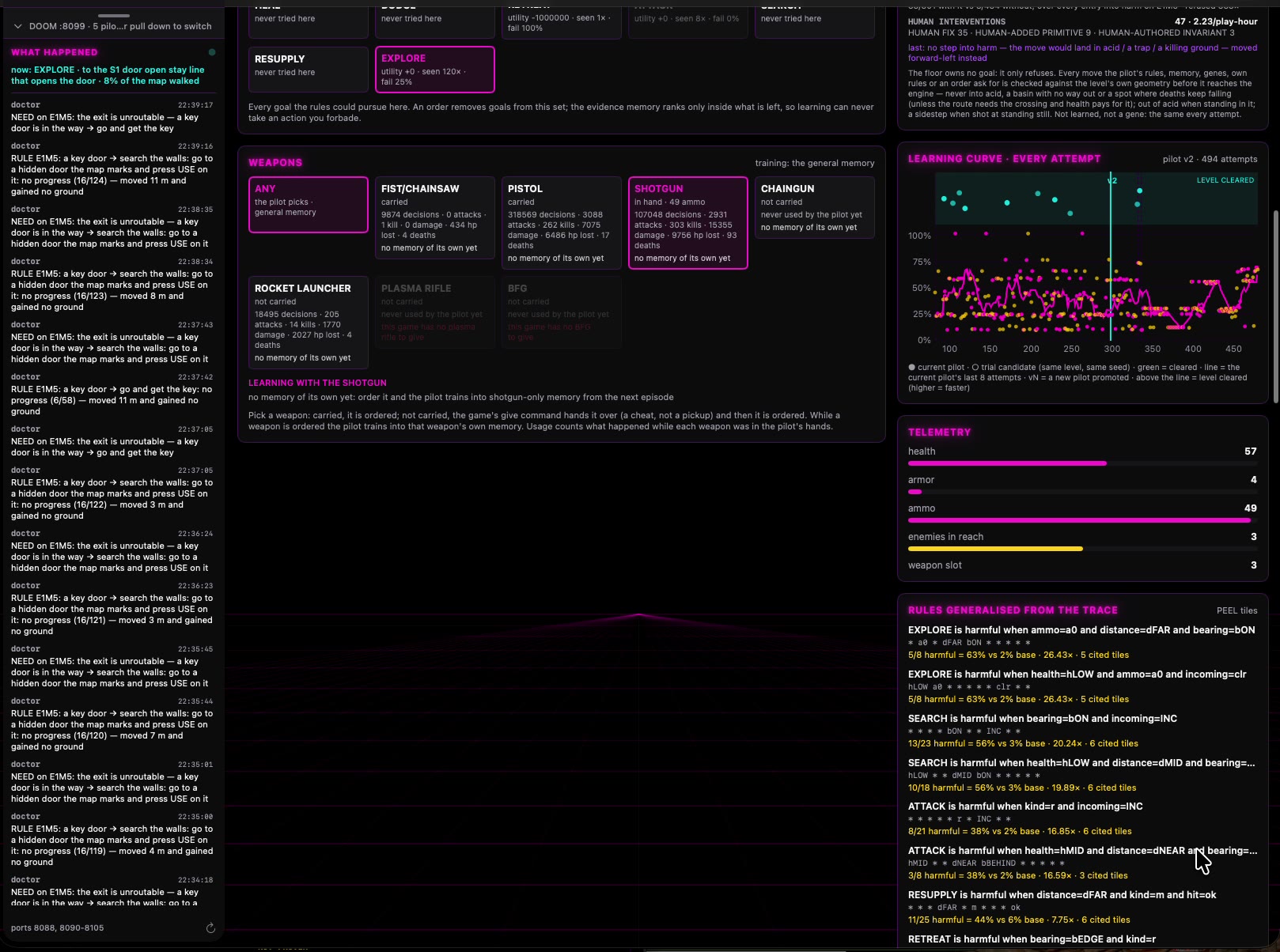
Peel: a weightless model with a fail-first architecture.
- Sensors
- Eye
- Peel
- Floor
- Trace
- Actuators
Weightless
No neural network inside. What it knows is explicit state and rules you can open and read.
Fail-first
Failure is the input. It learns during the mission, on the machine — no training run, no data centre.
One sealed brain
One signed file, checked before every run. A new body needs only a new adapter.
It writes its own rules. Nobody maintains them.
- Every failure is logged and explained.
- It proposes one change and runs it head-to-head against the old way, same level, same seed.
- Kept only if it wins clearly (z ≥ 2); thrown out if it loses. Then written out, in plain words, with the failures that earned it.

Proof, defense and offense, losses included.
| test | result | against us |
|---|---|---|
| Hostile driving controller | 64,952 of 64,952 bad commands overridden, 0 collisions | a boundary, not learning |
| Drone course, unseen starts | 10/10 clean laps vs 0/10 fresh | crashes at 2–3 m/s chase |
| Tank brain moved to a new game | +17%; +66% after pruning | a second export only broke even |
| BattleZone | 27,000 vs random 3,000 | a dodge rule rejected |
| DOOM E1M1, Hurt Me Plenty | exit at 52 s | Nightmare not cleared |
| 3D tank arena | −1.17 → −0.26 net kills/min, hand-written to evolved | still loses to the game’s AI |
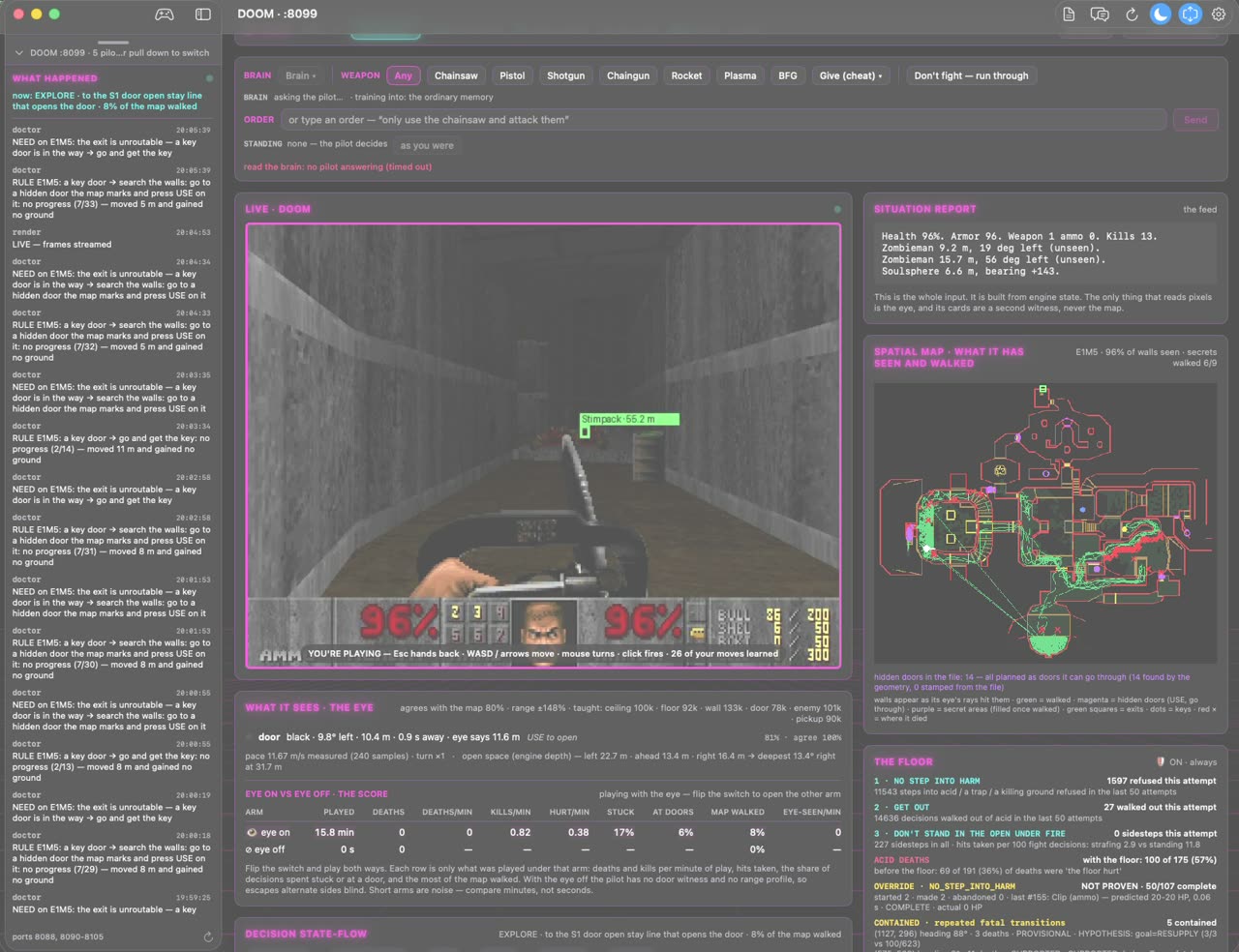
All measured in games and simulation, published with sample sizes.
5 / 15Would you let a chatbot drive your tank?
| driver, one 10-minute match | kills – deaths |
|---|---|
| the game’s own AI (years of tuning) | 38 – 6 |
| Our rule pilot | 20 – 20 |
| DeepSeek | 10 – 18 |
| Claude, 7.6 s per decision | 1 – 15 |
| Llama 3.2 3B | 0 – 10 |
- On a written exam of 8 tank situations: Peel 8/8, Claude 6/8, DeepSeek 5/8.
- A general model answers to its vendor’s policy, needs a link or a GPU, and can confidently make things up.
- Honest caveats: one match; Claude ran through its command-line tool; the game’s own AI beat us too.
Every endpoint, into one brain — even the ones with no API.
Old software, no API
Driven through its own buttons, fields and screens, with receipts. Shown in isolated copies of Windows 95 through 11.
Servers and mainframes
Through the ways in they already have. A COBOL answer is proven by a compiler, or refused.
Your failures, its rules
Failure telemetry becomes rules for the next system. Done once from a public record: 8,219 federal crash reports → 15 driving rules, 6 enforced.
No rip-and-replace, no new program of record. Not yet shown: military buses (MIL-STD-1553, ARINC 429, CAN) or any fielded system.
7 / 15Aligned to the commander. Not to a model.
People
Set authority, orders and ROE. Hold judgment over the use of force.
The floor
A deterministic mechanism enforcing machine-readable constraints derived from authorised policy, mission rules, safety limits and applicable ROE. Nothing it learns can widen them.
- Every decision leaves a written reason — replayable at the after-action review, same facts in, same decision out.
- Built toward DoD Directive 3000.09: “appropriate levels of human judgment over the use of force”.
Why this wins where neural autonomy struggles.
Cost
No GPU fleet, no training runs. The brain runs on the platform’s own computer.
Assurance
Deterministic and replayable: a path to test and certification that a black box does not have.
Field learning
Learns mid-mission from what went wrong, without a depot or a contractor.
Transfer
One brain across platforms; the adapter is the only new code.
Legacy reach
Connects systems that will never get an API.
Data you already own
Your failure telemetry is the training set — and it stays yours.
Where it plugs in, and how it pays.
Who uses it
- Primes and integrators building uncrewed air and ground systems.
- Program offices and test & evaluation teams that need replayable decisions.
- Sustainment of legacy systems with no API.
How it pays (plan)
- A brain licence per platform type.
- Integration: the adapter to your machine and your legacy endpoints.
- Evaluation contracts: shadow-mode studies on your recorded missions.
- Entry through SBIR/STTR, OTAs and teaming with primes.
No revenue yet. No partner integration yet.
10 / 1524 months, one gate at a time.
Each step has a gate written before it starts; nothing moves forward on a result we have not measured. Beyond 24 months: combat-capable humanoid platforms under human command.
Plan, not results. Today only simulation and games are built.
11 / 15A team of 5–7. Small on purpose.
Founder / architect
the brain, the floor, the evolver
Autonomy engineer
runtime, adapters, real-time
Robotics & HIL engineer
flight controllers, robots, humanoid
Legacy integration engineer
no-API systems, mainframes, buses
Test & evaluation lead
gates, protocols, independent tests
Security & compliance
CMMC path, export control, supply chain
Programs & partnerships
primes, program offices, SBIR/OTA
The founder is in place; the rest is the hiring plan. No GPU team needed: the brain has no weights to train.
12 / 15The ask: US$5–10M for 24 months.
Use of funds (plan)
What each end of the range buys
- US$5M: the core team, hardware-in-the-loop, low-cost robots, the first partner in shadow mode and then integrated.
- US$10M: all of that, plus the humanoid program and the ring, military-bus adapters, a second partner, and independent validation.
The risks, and how each one is retired.
| risk | how we retire it |
|---|---|
| Transfer is not automatic (a second export only broke even) | A written gate at every step; nothing advances on an unmeasured result |
| Where danger and the goal share one road, caution costs points (Freeway −12%) | Humans set those limits up front; the brain learns tactics, not authority |
| The eye’s margin is thin | It abstains instead of guessing; more real-sensor data in months 6–12 |
| Nothing fielded yet | Shadow mode first: it logs what it would do and touches nothing |
| Policy and trust | Human judgment over force, a deterministic floor, a replayable trace for every decision |
Why a prime should be in this round.
- One brain for the platforms you already build — air, ground, legacy — with only an adapter per platform.
- A decision record your test and evaluation teams can replay, and a floor your program office can read.
- Your failure telemetry turned into rules you own, not weights you rent.
- A small team, a 24-month plan with written gates, and results published with the losses.
Talk to us → Perslis Defense →
15 / 15